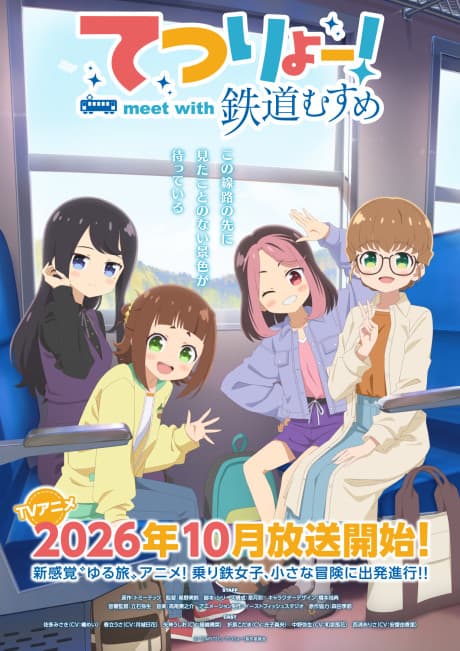
てつりょー!meet with 鉄道むすめ
Tetsuryo! meet with Tetsudou Musume is a laid-back travel anime about university students in a railway travel club who journey through a world where the Tetsudou Musume characters work. It premieres on October 8, 2026. The setting is not a single town: it is built on real Japanese railway operators, lines and stations. The official character page lists which Tetsudou Musume appear and which real railway companies they belong to, including Choshi Electric Railway, Chichibu Railway, Watarase Keikoku Railway, Tobu Railway, Seibu Railway, Tama Monorail, Keio, Hakodate City Tram, Keihan, Osaka Monorail and Linimo. OtakuTrips lists the officially confirmed operators and their real stations, and will add per-episode locations after the broadcast starts.

Anime pilgrimage guide
てつりょー!meet with 鉄道むすめ
Tetsuryo! meet with Tetsudou Musume is a laid-back travel anime about university students in a railway travel club who journey through a world where the Tetsudou Musume characters work. It premieres on October 8, 2026. The setting is not a single town: it is built on real Japanese railway operators, lines and stations. The official character page lists which Tetsudou Musume appear and which real railway companies they belong to, including Choshi Electric Railway, Chichibu Railway, Watarase Keikoku Railway, Tobu Railway, Seibu Railway, Tama Monorail, Keio, Hakodate City Tram, Keihan, Osaka Monorail and Linimo. OtakuTrips lists the officially confirmed operators and their real stations, and will add per-episode locations after the broadcast starts.
Pilgrimage guide on this page
Tetsuryo! meet with Tetsudou Musume is a laid-back travel anime about university students in a railway travel club who journey through a world where the Tetsudou Musume characters work. The setting is not a single town: it is built on real Japanese railway operators, lines and stations. The official character page lists the Tetsudou Musume who appear together with the real railway companies they belong to, including Choshi Electric Railway, Chichibu Railway, Watarase Keikoku Railway, Tobu Railway, Tobu Top Tours, Seibu Railway, Tama Monorail, Keio Corporation, Yokohama Seaside Line, Yokohama Municipal Transportation Bureau, Hakodate City Tram, Keihan Electric Railway, Osaka Monorail, Aichi Rapid Transit (Linimo), Nishi-Nippon Railroad, Matsuura Railway, Shimabara Railway, JR East Technoheart TESSEI. This page separates what is officially confirmed from what is still unconfirmed.
Quick answer
Tetsuryo! is set across real Japanese railway lines. As of August 2026 the only officially confirmed information is which Tetsudou Musume appear and which real railway operators they belong to. Which stations and areas appear in each episode will be known after the broadcast starts on October 8, 2026.
Everything below is published on the official website or official character page. Follow the source links to check the original.
Nothing in this section has been officially announced. We state it as unconfirmed and move items up to the confirmed section once verified.
Episode 1 is scheduled for October 8, 2026. Stations, lines and areas shown in each episode will be added here after broadcast.
Visiting manners
Stations, platforms and trains are public spaces in daily use. Take photos only where you do not disturb other passengers or staff, and never step beyond platform edges, onto tracks, or into restricted areas. On rural lines and unstaffed stations, buying a ticket or local goods is itself a way to support the line.
Ad
Start by browsing the real-world spots connected to this anime, then open the map when you are ready to plan the route.

Photo: MaedaAkihiko via Wikimedia Commons (CC BY-SA 4.0) — https://commons.wikimedia.org/wiki/File:Tokawa-STA_Outside.jpg
外川駅(銚子電気鉄道)
The terminus of the Choshi Electric Railway line. Its wooden station building dates from the 1923 opening, making it one of the few Taisho-era stations left in the Kanto region. From here you can walk downhill into the fishing-port streets.
Photo by Vantey (Public domain) via Wikimedia Commons
学園都市のモノレール駅のモデルで、ガラス張りの近未来的な駅舎が作品の世界観を再現。
Photo by MaedaAkihiko (CC BY-SA 4.0) via Wikimedia Commons
西武新宿線の終着駅。作品のキャラクターたちの生活圏に含まれる。
Next step
Build a quick itinerary yourself or discuss the trip with a specialist.
Travel map
See how the pilgrimage spots sit together before you start planning the day.
After the trip
A softer place for watch-again and related-item links around this title.
Photo: Gnsin via Wikimedia Commons (CC BY-SA 3.0) — https://commons.wikimedia.org/wiki/File:Linimo_of_Yakusa_Station_01.JPG
八草駅(愛知高速交通リニモ・愛知環状鉄道)
The interchange between the Aichi Loop Line and Linimo, Japan's only commercially operating magnetic-levitation line. From here you can head toward Expo 2005 Aichi Commemorative Park (Moricoro Park).

Photo: 663highland via Wikimedia Commons (CC BY 2.5) — https://commons.wikimedia.org/wiki/File:170826_Kinugawa_Onsen_Station_Nikko_Japan02s3.jpg
鬼怒川温泉駅(東武鉄道)
A station on the Tobu Kinugawa Line and the gateway to the Kinugawa Onsen hot-spring town. Spacia limited expresses and sightseeing trains call here, and there is a footbath in front of the station. It works well as a base for the Nikko and Kinugawa area.

Photo: BATACHAN via Wikimedia Commons (CC BY-SA 4.0) — https://commons.wikimedia.org/wiki/File:%E6%9D%BE%E9%A2%A8%E7%94%BA%E5%81%9C%E7%95%99%E5%A0%B4%E3%83%BB%E5%85%A8%E6%99%AF%EF%BC%882018.03%EF%BC%89.jpg
松風町停留場(函館市電)
A tram stop within walking distance of JR Hakodate Station. It was once a junction where several tram routes met, and traditional shopping streets remain nearby.

Photo: くろふね via Wikimedia Commons (CC BY 3.0) — https://commons.wikimedia.org/wiki/File:%E7%8A%AC%E5%90%A0%E9%A7%85_-_panoramio_(3)(cropped).jpg
犬吠駅(銚子電気鉄道)
A station on the Choshi Electric Railway line, selected as one of the Kanto region's 100 finest stations. The Inubosaki Lighthouse at the easternmost tip of Honshu is within walking distance, making this the sightseeing base of the line.

Photo: Asanagi via Wikimedia Commons (CC0) — https://commons.wikimedia.org/wiki/File:South_entrance_of_Kami-Igusa_Station_(1)_2022-09-04.jpg
上井草駅(西武鉄道)
A station on the Seibu Shinjuku Line and the northernmost station in Suginami ward. The area is known for its concentration of anime studios, with a quiet shopping street and residential blocks around the station.

Photo: 運動会プロテインパワー via Wikimedia Commons (CC BY-SA 4.0) — https://commons.wikimedia.org/wiki/File:Ishiyamadera_station_202410-1.jpg
石山寺駅(京阪電気鉄道)
The southern terminus of the Keihan Ishiyama Sakamoto Line, on the bank of the Seta river. Ishiyamadera temple, associated with Murasaki Shikibu, is within walking distance. It anchors the southern end of the line around southern Lake Biwa.

Photo: Asturio Cantabrio via Wikimedia Commons (CC BY-SA 4.0) — https://commons.wikimedia.org/wiki/File:Ashio_Station_ac_(1).jpg
足尾駅(わたらせ渓谷鐵道)
A station on the Watarase Keikoku Line whose wooden station building and preserved rolling stock on the siding recall its mining-railway past. It sits on the route of the trolley trains that run through the Watarase river gorge.
Photo: 京浜にけ via Wikimedia Commons (CC BY-SA 3.0) — https://commons.wikimedia.org/wiki/File:Saitama_Sakurazawa_Station_Entrance_1.JPG
桜沢駅(秩父鉄道)
A station on the Chichibu Main Line, on the eastern side of Yorii town. Heading toward Chichibu from here, the line follows the Arakawa river valley. It is a quiet, unstaffed local station.